
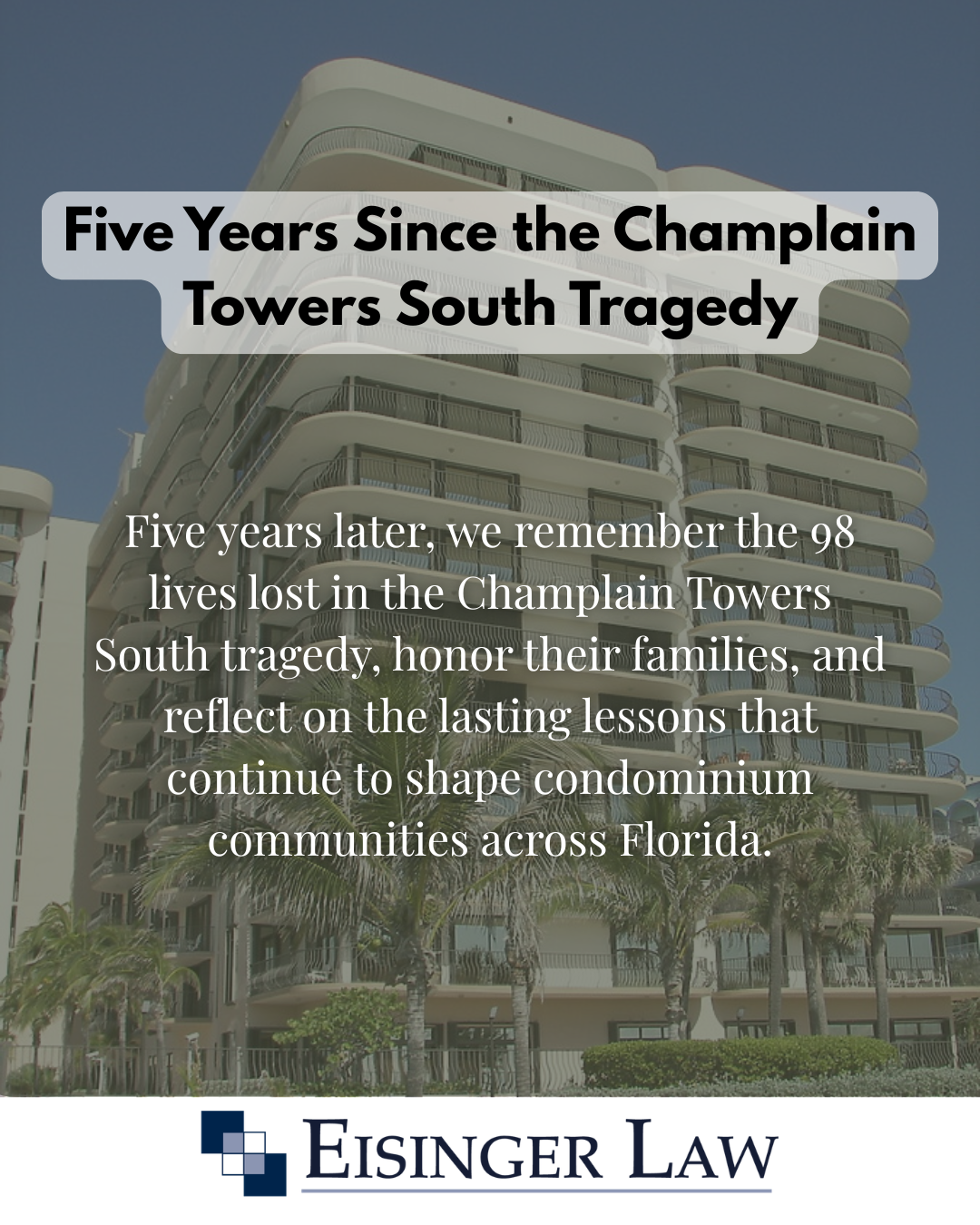
Five Years After Champlain Towers South: What NIST’s New Findings Mean for Florida Condominiums
Today marks five years since the collapse of Champlain Towers South in Surfside, claiming 98 lives and permanently changing the landscape of condominium law, regulation, and association governance in Florida. As a firm dedicated exclusively to representing condominium associations, HOAs, and their boards, we have spent these five years living through the aftermath of that tragedy alongside our clients, and we want to mark this anniversary by reflecting on what has changed, what we learned this week, and what remains the most important lesson of all.
What We Learned This Week
This past Monday, June 22, the National Institute of Standards and Technology released the technical findings of its National Construction Safety Team investigation into the cause of the collapse. After nearly five years of physical evidence analysis, materials testing, and computational modeling, NIST’s investigators concluded that the failure sequence began weeks before the building came down, not at 1:00 a.m. on June 24, 2021, but in early June of that year, when two connections between garage columns and the pool deck slab experienced what engineers call a punching shear failure. Those initial failures did not immediately bring the building down. Instead, the surrounding pool deck and street level parking structure absorbed the redistributed loads, placing additional stress on neighboring connections that were already compromised. Over the following weeks, the southern edge of the pool deck became unseated from its supporting wall, the slab sagged and ultimately broke away from the building, and that break damaged the connections supporting the middle and east sections of the tower, triggering the collapse that took 98 lives.
NIST’s investigators were direct in attributing the failure to a combination of factors rooted in the building’s original design and construction in 1981, compounded by decades of added load and long term deterioration. The report identifies design deficiencies and construction deviations from the original plans, along with loads that were never contemplated in the original design, including planter boxes not reflected in the architectural drawings and later rehabilitation work that added pavers and sand bedding to portions of the pool deck. Long term corrosion and deterioration provided what investigators described as the final link in the failure sequence. Importantly, NIST’s findings rule out a number of theories that circulated in the years following the collapse, including construction vibrations, sinkholes, foundation failure, and storm surge.
It is worth noting precisely what was released this week and what is still to come. NIST issued its technical findings on the cause of the collapse, not yet the complete final report. The full report, which will include the underlying evidence analysis and, critically, recommendations for changes to building codes, standards, and industry practice, is still being finalized. We will be watching closely for that report and what it may mean for inspection and maintenance obligations going forward, and we will keep our clients informed as those recommendations take shape.
Five Years of Change in Florida Condominium Law
The legislative response to Surfside reshaped our practice area in ways that are now simply part of how Florida condominiums and cooperatives operate. The Legislature’s enactment of mandatory structural integrity reserve studies and the elimination of the ability to waive reserves for the items those studies cover represented the most significant change to Chapter 718 in a generation. Statewide milestone inspection requirements under section 553.899 brought a formal, statutory framework to a process that had previously been left largely to the discretion of individual associations and their boards. For many of our clients, the last five years have meant difficult conversations about special assessments, reserve funding, and the real cost of deferred maintenance, conversations that were often unwelcome but that we believe have left associations in a fundamentally stronger position than they were in 2021.
We have also seen the practical, on the ground impact of these changes in our daily work, from engineering reports and milestone inspection compliance to reserve study disputes and the financing challenges that come with funding decades of deferred maintenance in a compressed timeframe. These are not abstract policy questions for our clients. They are board members, often volunteers, who are now legally responsible for understanding structural engineering reports and budgeting for reserve obligations in a way that simply was not required of them before 2021.
The Lesson That Still Matters Most
Whatever the final NIST report ultimately recommends in terms of code and standard changes, the lesson of the last five years for those of us who practice in this area has not changed. Regular inspection and proactive maintenance are not bureaucratic checkboxes. They are the mechanism by which problems that begin small, a crack, a corroded connection, a load the original design never anticipated, are caught before they become catastrophic. Florida’s new statutory framework for milestone inspections and structural integrity reserve studies exists because the old system of discretionary, optional maintenance planning failed the residents of Champlain Towers South. Compliance with these requirements is not simply a matter of avoiding liability. It is, as this week’s findings remind us in the starkest possible terms, a matter of life and safety.
As we mark this anniversary, our thoughts remain with the 98 victims of the collapse and their families, and with the survivors who continue to carry the weight of that night. We remain committed to helping the associations and boards we represent meet their obligations under this new legal framework, not as a matter of compliance alone, but because we understand, perhaps more than most, exactly what is at stake when those obligations are ignored.


